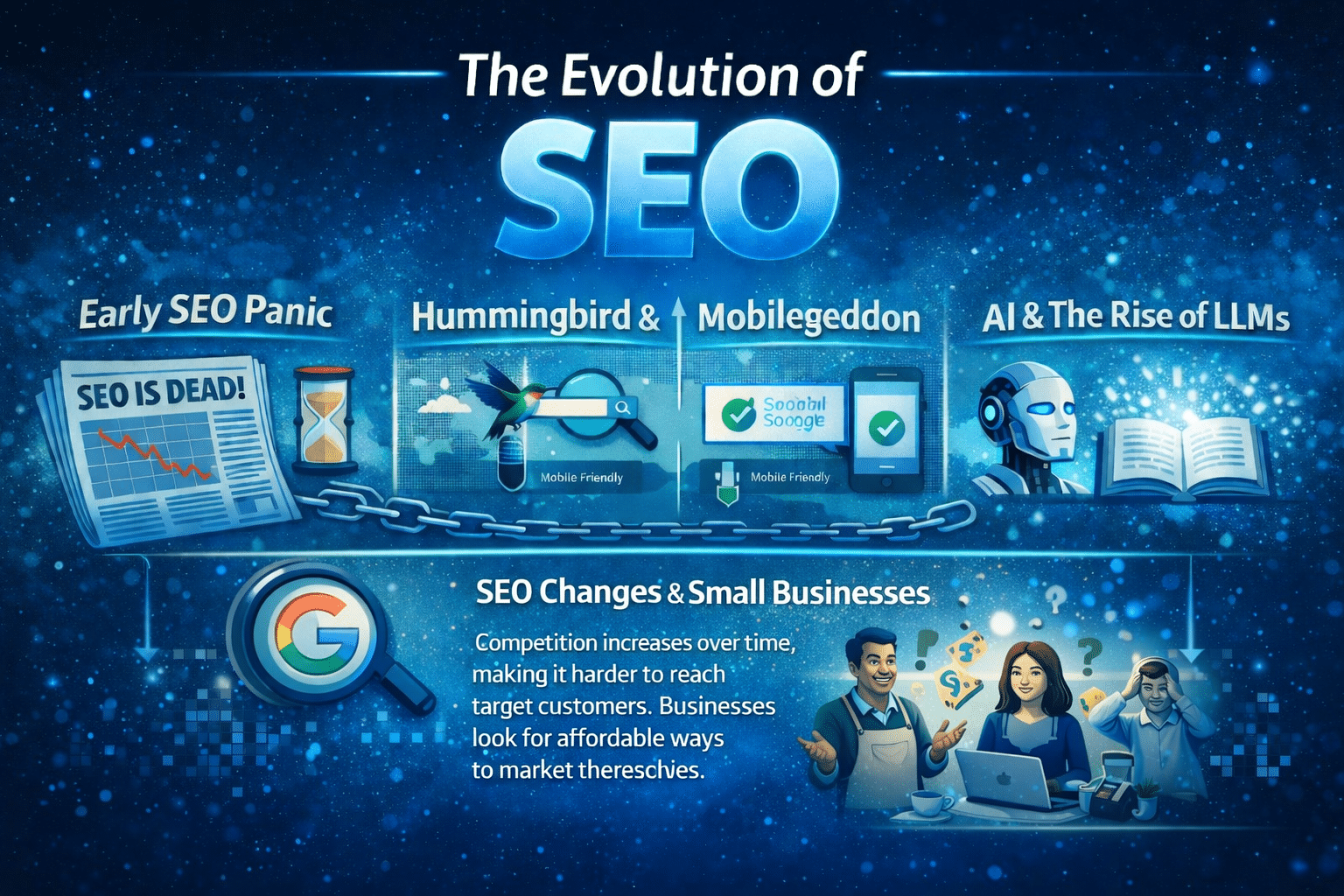
If you’ve worked in digital marketing long enough, you’ve heard it more times than you can count:
“SEO is dead.”
The phrase resurfaces every few years—usually after a major Google update, a new platform shift, or a wave of industry panic. Each time, headlines predict the end of organic search as we know it. And each time, SEO doesn’t disappear.
It adapts.
Below is a closer look at the major moments when SEO was declared dead, what industry leaders were actually saying, and how the discipline evolved into the highly measurable, scalable marketing channel it is today.
1997–2000: “Search Engines Will Make SEO Obsolete.”
What Was Being Said
In the late 1990s, search engines like Lycos, AltaVista, and Yahoo relied heavily on on-page signals—meta keywords, keyword density, and basic HTML structure. Rankings were often easy to manipulate.
When Google entered the market with PageRank, using links as a signal of authority, many technologists believed algorithms would quickly become so advanced that optimization wouldn’t be necessary at all.
Industry Sentiment
“Eventually, search engines will just understand content. You won’t need to optimize for them.”
— Common sentiment among early web technologists, late 1990s
Why SEO Was “Dead”
The thinking was simple: if algorithms become intelligent enough to interpret content perfectly, then there’s no room—or need—for SEO.
How SEO Adapted
Instead of disappearing, SEO matured. It shifted from simple keyword stuffing to more strategic efforts, including:
- Link building as a credibility and authority signal
- Thoughtful information architecture
- Crawlability and proper indexation
- Early concepts of trust and domain authority
Google didn’t eliminate SEO. It formalized it. Optimization became less about tricking engines and more about aligning with how they evaluated quality.
2003: Google Florida Update — “SEO Is Impossible Now.”
What Was Being Said
In November 2003, Google released the Florida update. Overnight, thousands of websites—especially affiliate and e-commerce sites—lost rankings. Many relied heavily on keyword stuffing, hidden text, and exact-match tactics.
Industry Reaction
“SEO is dead. Google just destroyed the industry.”
— WebmasterWorld forum reactions, November 2003
Forums were filled with panic. Businesses that relied on organic traffic saw revenue collapse almost instantly.
Why SEO Was “Dead”
Rankings suddenly felt unpredictable. Tactics that had worked for years stopped working in a single update. Many marketers believed Google had made rankings uncontrollable.
How SEO Adapted
Florida marked a turning point. It pushed SEO toward:
- Content quality over keyword density
- Natural, diversified link profiles
- Semantic relevance instead of repetition
- Long-term strategy instead of short-term loopholes
This was Google’s first major, unmistakable message: manipulation does not scale.
The SEO industry didn’t die. It professionalized.
2010–2012: “Social Media Killed SEO.”
Key Moment
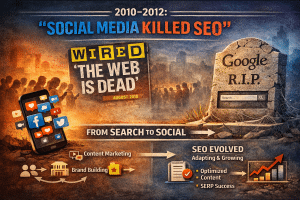
2010 – Wired publishes “The Web Is Dead.”
What Was Being Said
With Facebook and Twitter exploding in popularity, many marketing influencers predicted that social platforms would replace search. Users would no longer “look” for content—they would be fed content algorithmically.
Notable Quote
“People are spending more time in apps and social networks than on the open web.”
— Wired Magazine, August 2010
Why SEO Was “Dead”
If discovery happened inside social platforms and apps, search engines would become less relevant. Organic search traffic would decline permanently.
How SEO Adapted
Instead of competing with social, SEO expanded to complement it. Strategies evolved to include:
- Content marketing at scale
- Brand visibility and authority building
- Share-worthy, link-earning assets
- SERP click-through optimization
Search demand didn’t disappear. In fact, as more content was created and shared socially, search volume grew. Users still turned to Google when they needed answers, comparisons, or help with buying decisions.
SEO became part of a larger digital ecosystem—not a standalone tactic.
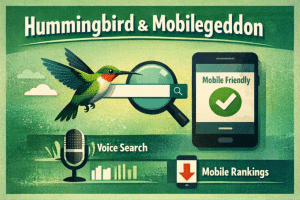
2013–2015: Hummingbird & Mobile — “Keywords Don’t Matter Anymore.”
Key Dates
- Hummingbird: August 2013
- Mobile-Friendly Update (“Mobilegeddon”): April 21, 2015
What Was Being Said
Hummingbird enabled Google to understand search intent and conversational queries better. It wasn’t just matching keywords anymore—it was interpreting meaning.
Then came the mobile-friendly update, which significantly impacted sites that weren’t optimized for mobile devices.
Google’s Own Words
“Hummingbird is designed to understand the meaning behind the words better.”
— Amit Singhal, Google SVP, 2013
Industry commentary at the time captured the disruption:
“With Hummingbird and the mobile update, a lot of traditional SEO tactics simply stopped working. For many businesses, it felt like Google had pulled the rug out from under them.”
— Danny Sullivan, summarized in Search Engine Land, 2015
Why SEO Was “Dead”
If Google could understand intent and context, some believed traditional keyword optimization was obsolete. Add mobile ranking factors, and many felt the technical bar had become too high.
How SEO Adapted
SEO didn’t abandon keywords—it reframed them within context. Strategies evolved into:
- Topic clusters and content hubs
- Intent mapping across the buyer journey
- Mobile UX optimization
- Page speed and usability improvements
- Depth and comprehensiveness over exact-match phrasing
Keywords didn’t disappear. They became part of a broader semantic strategy.
SEO moved from phrases to problems.
2015: RankBrain — “Machines Do SEO Now.”
What Was Being Said
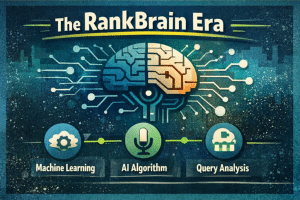
In 2015, Google announced RankBrain, a machine learning system designed to interpret unfamiliar queries and refine search results based on user behavior.
Notable Quotes
“RankBrain is the third most important ranking signal.”
— Greg Corrado, Google, Bloomberg interview, 2015
“RankBrain is not about understanding content, but understanding queries and how users interact with results.”
— Gary Illyes, Google Webmaster Trends Analyst, 2016
Industry reaction was dramatic:
“RankBrain means traditional SEO is becoming obsolete. If Google’s machine learning systems decide relevance on their own, optimization as we know it is effectively dead.”
— Barry Schwartz summarizing reactions, Search Engine Roundtable, 2015
Why SEO Was “Dead”
If machine learning determined relevance dynamically, marketers assumed human influence over rankings would diminish.
How SEO Adapted
RankBrain reinforced a vital point: user behavior matters.
SEO shifted toward:
- Improving click-through rates
- Increasing dwell time and engagement
- Aligning precisely with search intent
- Creating content that fully satisfies queries
The focus moved from “How do we rank?” to “How do we serve users better than anyone else?”
Machines didn’t replace SEO. They raised the bar for quality.
2018–2019: Zero-Click Searches — “SEO Doesn’t Drive Traffic Anymore.”
What Was Being Said
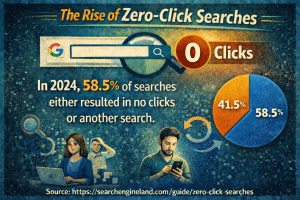
Featured snippets, People Also Ask boxes, and knowledge panels began answering questions directly in the SERPs.
Notable Quotes
“More than 50% of searches now end without a click.”
— SparkToro study, 2019
“As Google answers more questions directly in the SERPs, publishers are seeing declining organic traffic even when rankings remain strong, fundamentally challenging the traditional SEO value proposition.”
— Rand Fishkin, 2019
Why SEO Was “Dead”
If users didn’t need to click, what was the value of ranking?
How SEO Adapted
Success metrics expanded. SEO evolved to include:
- SERP real estate ownership
- Featured snippet optimization
- Local pack and map visibility
- Brand reinforcement at the top of search
- Conversion-driven landing experiences
Visibility became as important as traffic. Even zero-click impressions strengthened brand recognition and authority.
SEO stopped being measured solely by clicks—and started being measured by influence.
2023–2025: AI, SGE & LLMs — “This Time SEO Is Really Dead.”
What Was Being Said
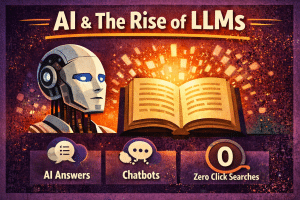
With the rise of ChatGPT, Google’s Search Generative Experience (SGE), and AI-powered summaries, the panic returned—louder than ever.
Common Claims
“AI will fundamentally disrupt search in a way that makes traditional SEO strategies far less relevant, if not obsolete.”
— Gartner analyst commentary, 2023
“Large language models remove the incentive to visit websites at all, which threatens the entire SEO-driven content economy.”
— Eli Schwartz, 2023
Why SEO Was “Dead”
If AI could generate answers instantly, why would users click through to websites?
How SEO Is Adapting Now
Modern SEO is evolving in real time, focusing on:
- Entity authority and E-E-A-T signals
- Brand recognition within AI-generated answers
- Structured data and schema implementation
- First-party data strategies
- Conversion optimization and owned audiences
- Content built for both humans and machines
AI isn’t replacing SEO. It’s reshaping it—just like every major shift before.
The businesses that adapt will thrive. The ones clinging to outdated tactics will struggle.
SEO Isn’t Dead. It’s Just Allergic to Complacency.
Every time SEO has been declared dead, it wasn’t the end of optimization.
It was the end of shortcuts.
SEO has survived:
- Major algorithm updates
- The rise of social platforms
- The mobile revolution
- Machine learning systems
- Zero-click SERPs
- Generative AI
It continues to thrive because it evolves alongside how people search, consume information, and make decisions.
What This Means for Businesses Today
SEO today isn’t about gaming algorithms. It’s about aligning with how search engines and users actually behave.
That means:
- Building real authority
- Creating genuinely useful content
- Optimizing technical performance
- Connecting search visibility to measurable revenue
At Higher Images, we continuously test, implement, and refine strategies that align with where search is going—not where it used to be.
Our approach includes:
- AI-driven search intelligence
- Advanced technical SEO
- Conversion-focused content strategy
- Local and entity-based optimization
- Performance tracking tied directly to KPIs and revenue
If you want to see how modern SEO and AI-powered marketing can drive measurable performance—not just rankings—contact Higher Images to learn how we’re helping businesses win in today’s search landscape.
Virtual Marketing Officer
Alex Rutkowski is a seasoned digital marketing strategist with nearly 30 years of experience helping small and medium-sized businesses grow through data-driven SEO and PPC strategies. A graduate of Carnegie Mellon University, Alex has a deep understanding of digital marketing, from search engine optimization and paid advertising to comprehensive ma



 View Our Work